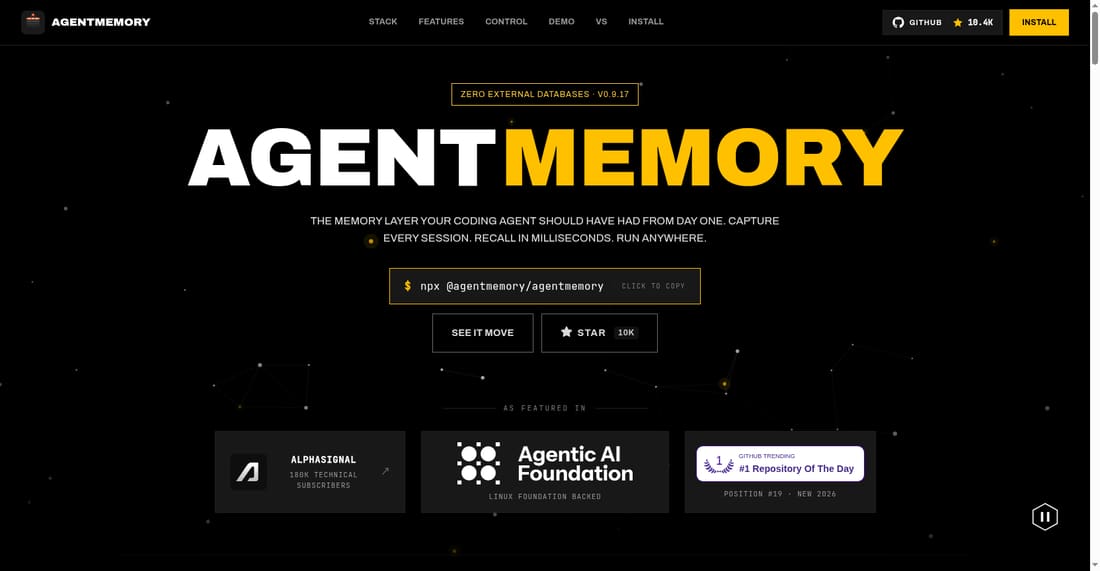
Agentmemory is a complete memory runtime for coding agents, capturing every session via auto-hooks, recalling in milliseconds with triple-stream retrieval (BM25 + vector + graph), and consolidating memories hourly. It runs without external databases, supports MCP tools, and works with Claude Code, Cursor, and more.
Free
How to use Agentmemory?
Install via npm or npx, start the memory server, and wire it to any MCP-compatible agent (e.g., Claude Code, Cursor). It auto-captures tool calls and prompts, enabling instant recall and session replay. Use it to avoid retraining agents across sessions, reduce input tokens, and maintain persistent context.
Agentmemory 's Core Features
Auto-hooks: 12 built-in hooks capture every tool call, prompt, and stop without glue code, piping data into the memory pipeline.
Triple-stream recall: Combines BM25, vector, and knowledge graph retrieval with on-device reranking, achieving 95.2% R@5 on LongMemEval-S.
Auto-consolidation: Hourly sweeps compress raw observations into semantic memories, merging duplicates and decaying stale rows.
Zero external databases: Runs as a single Node process with disk-based JSON storage, eliminating the need for Redis, Kafka, or Postgres.
MCP and REST surface: 51 MCP tools and 121 REST endpoints for memory operations, governance, audit, and export.
Federation: Peer-to-peer sync between agentmemory nodes over authenticated HTTPS for distributed memory sharing.
Observability: Built-in OTEL tracing and logging with spans for every operation, exportable to Jaeger or Honeycomb.
Agentmemory 's Use Cases
Developers using Claude Code or Cursor who need persistent memory across sessions to avoid repeating context.
Teams building multi-agent systems that require shared memory and session replay for debugging.
Researchers running long experiments with coding agents who need to recall past tool calls and outputs.
DevOps engineers automating workflows with MCP-compatible agents needing reliable memory without extra infrastructure.
Open-source contributors integrating memory into custom agents via REST or MCP endpoints.
Students learning AI agent development who want a zero-config memory runtime for their projects.